Understanding Business Loans
How to calculate business loan repayments – Business loans are essential financial tools that enable enterprises to access the capital needed for growth, operations, and investment. Understanding the various types of business loans available is crucial for making informed decisions.
Types of Business Loans
Several types of business loans cater to different needs and situations:
- Term Loans: These loans provide a lump sum that is repaid over a set period, usually with fixed monthly payments.
- Lines of Credit: A flexible loan option allowing businesses to borrow up to a certain limit and only pay interest on the amount used.
- SBA Loans: Loans backed by the Small Business Administration that offer favorable terms for small businesses.
- Equipment Financing: Secured loans used to purchase business equipment, where the equipment itself serves as collateral.
- Invoice Financing: A type of borrowing against the amounts due from customers, providing quick access to cash.
Importance of Loan Terms and Conditions
Before applying for a business loan, understanding the specific terms and conditions is vital. This includes the interest rate, repayment schedule, and any fees associated with the loan. Knowing these details helps businesses avoid surprises and make strategic financial decisions.
Common Reasons Businesses Seek Loans
Businesses often seek loans for various reasons, including:
- Expanding operations or opening new locations.
- Purchasing inventory or equipment.
- Managing cash flow during slow seasons.
- Investing in marketing or technology upgrades.
Key Components of Loan Repayment: How To Calculate Business Loan Repayments
When calculating loan repayments, several key components must be considered.
Main Components of Loan Repayment
The main components involved in loan repayment calculations include:
- Principal: The original amount borrowed from the lender.
- Interest: The cost of borrowing, expressed as a percentage of the principal.
- Repayment Terms: The schedule and duration over which the loan must be repaid.
Loan Amount and Monthly Repayments
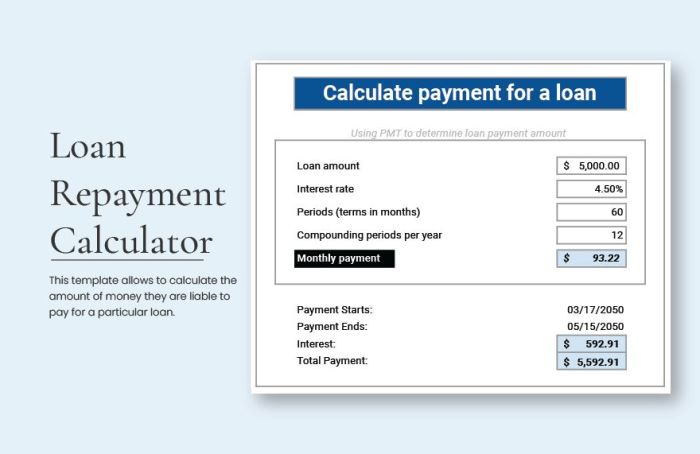
The total loan amount directly affects the monthly repayments. A larger loan typically results in higher monthly payments, while a smaller loan may be more manageable. Understanding how these factors interplay can help businesses plan their budgets more effectively.
Calculating Monthly Loan Repayments
Calculating the monthly repayments of a business loan requires a clear formula.
Loan Repayment Formula
The general formula for calculating monthly loan repayments is given by:
M = P[r(1 + r)^n] / [(1 + r)^n – 1]
Where:
- M = total monthly payment
- P = principal loan amount
- r = monthly interest rate (annual rate / 12)
- n = number of payments (loan term in months)
Using an Online Calculator
Many online calculators simplify this process. To use one:
- Input the loan amount in the designated field.
- Enter the annual interest rate.
- Specify the loan term in years.
- Click on the calculate button to receive your monthly repayment amount.
Example Scenario
For example, consider a loan of $50,000 with a 5% annual interest rate and a term of 10 years. The monthly payment can be calculated as follows:
M = 50000[0.004167(1 + 0.004167)^120] / [(1 + 0.004167)^120 – 1]
This results in a monthly payment of approximately $530.33.
Understanding Interest Rates
Interest rates significantly impact the overall cost of a business loan and the monthly repayments.
Fixed vs. Variable Interest Rates
The main types of interest rates are:
- Fixed Rates: These remain constant during the life of the loan, providing predictable payment amounts.
- Variable Rates: These can fluctuate based on market conditions, potentially leading to lower initial payments but increased risk over time.
Impact of Interest Rates on Loan Costs
A higher interest rate increases the total cost of the loan and monthly repayments. Businesses should aim to secure the lowest possible rate to minimize expenses.
Factors Influencing Interest Rates
Several factors can influence the interest rates of business loans, including:
- Creditworthiness of the business and its owners.
- Market interest rates.
- Loan amount and term.
- Type of collateral offered.
Using Amortization Schedules
An amortization schedule is a detailed table that Artikels each loan repayment over time.
Purpose of Amortization Schedules
Amortization schedules serve to:
- Clearly display how much of each payment goes toward the principal versus interest.
- Provide a timeline for total loan payoff.
Creating an Amortization Schedule
To create an amortization schedule:
- Determine the loan amount, interest rate, and term.
- Calculate monthly payments using the formula mentioned earlier.
- Break down each payment into principal and interest for each month.
Sample Amortization Table
A sample amortization table could include:
| Month | Payment | Principal | Interest | Remaining Balance |
|---|---|---|---|---|
| 1 | $530.33 | $427.33 | $103.00 | $49,572.67 |
| 2 | $530.33 | $428.18 | $102.15 | $49,144.49 |
Impact of Loan Terms on Repayment
The length of a loan term plays a crucial role in determining monthly payments and total interest paid.
Loan Term Length and Monthly Payments
A longer loan term typically results in lower monthly payments but increases the total interest paid. Conversely, shorter terms mean higher monthly payments but less total interest.
Comparing Loan Term Lengths
Different loan terms come with their own advantages and disadvantages:
- Short-Term Loans: Higher payments but lower interest costs.
- Long-Term Loans: Lower payments but potentially higher total interest.
Aligning Loan Terms with Cash Flow Projections
Choosing a loan term that aligns with cash flow projections is vital for maintaining financial health. Businesses must assess their revenue cycles to select a term that supports their repayment capabilities.
Prepayment and Its Effects
Loan prepayment allows borrowers to pay off their loans early, which can have several benefits.
Benefits of Loan Prepayment
Prepayment can lead to:
- Reduced interest costs over the life of the loan.
- Increased financial flexibility.
Potential Penalties for Prepayment
Some lenders may impose prepayment penalties, which can offset the benefits of paying off a loan early. It is essential to review the loan agreement for any such clauses.
Scenarios for Prepayment, How to calculate business loan repayments
Prepayment may be advantageous when:
- Cash flow is strong, allowing for early payoff without financial strain.
- The interest rate on the loan is high compared to market rates.
- Conversely, prepaying might not be ideal if cash reserves are low or if penalties significantly reduce savings.
Tips for Managing Loan Repayments
Effectively managing loan repayments is crucial for maintaining business health.
Budgeting Strategies
Creating a budget that prioritizes loan repayments can help ensure timely payments. This might involve setting aside a specific percentage of revenue each month for loan repayment purposes.
Maintaining Cash Flow
Ensuring adequate cash flow is vital for meeting repayment obligations. Businesses should track income and expenses closely, adjusting their operations as needed to maintain positive cash flow.
Monitoring Loan Repayment Schedules
A checklist for monitoring loan repayment schedules could include:
- Reviewing payment dates and amounts regularly.
- Setting reminders for payment due dates.
- Updating financial forecasts to include loan repayments.